My aim is not to recount the story chronologically, nor fully cover its contents.
On Madness and divine recollection
Socrates introduces the Four Divine Maniai (theia mania) as part of his response to Lysias’s sōphrosynē (sober rationality). According to Socrates, the greatest goods are bestowed upon through divine madness rather than human prudence/rationality. The context for this claim follow Lysias’s speech where he makes the claim that the lover ought to give gifts to the non-loved, precisely because his thinking is clean and unaffected by his passions.
Socrates’s last manifestation of madness is the erotic mania. It operates through recollection (anamnēsis). He builds on what he has previously recounted, the myth of the soul’s chariot ride, where the soul is in the presence of forms, the intelligible and maximally value-laden realm. Every soul has glimpsed the Forms throughout its chariot ride, however the degree of vision differs from one soul to the other. Souls that saw much retained a proportional amount, and the shock of recollection is proportional as well. Most souls pursued the beloved carnally, without contact to higher forms. This is why mania is a shock, between partial recollection and full recollection. The friction is between the soul (that which is capable of contemplating the infinite) and its finite cage. For Lysias and his self-interested rationalism, it would then follow that this is the instance where the soul is in a diminished condition, mistaking forgetfulness for clarity. That the madness is divine comes from the excessive activation of the soul, almost in a flash. Think of it this way: a person who has never seen colour cannot be overwhelmed by it. A person who sees colour perfectly and inhabits a world of colour has no dissonance. The madness belongs to the one who remembers colour while trapped in a grey world, who is undone by a single flash of red because it activates a capacity the surrounding environment cannot satisfy.
On rhetoricians and truth
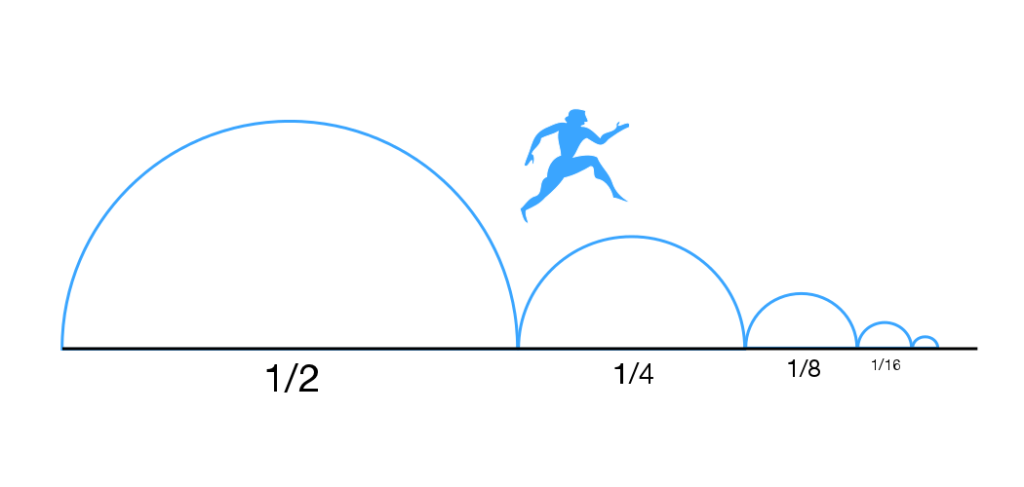
Socrates highlights the exploits that rhetoricians can make us of when they are not constrained or preoccupied by the truth. He points to a famous Eleatic paradox (Zeno of Elea, commonly known as Zeno’s paradox), which goes along these lines:
Suppose Atalanta wishes to walk to the end of a path. Before she can get there, she must get halfway there. Before she can get halfway there, she must get a quarter of the way there. Before travelling a quarter, she must travel one-eighth; before an eighth, one-sixteenth; and so on.
It then follows that over a finite length no motion could be completed, and concludes that motion is an illusion. Socrates provides insight on deception and explains that it operates through small increments between things that are similar, for taking either small or big leaps between dissimilar things produces no deception at all. It then follows for Socrates that a true rhetorician must be a dialectician, someone who has knowledge of said things and can collect and divide them at their joints. Without this skill, one cannot deceive, nor can one detect when they are being deceived.
It is interesting to note that “continuous motion” is precisely the blind spot between discursive reasoning (dianoia) and continuous reality. This is the gap that rhetoricians can exploit, and why Zeno’s paradoxes work on us. This further connects to Socrates’ next thesis on writing and speech.
On writing and written words
Reasoning that proceeds step by step through propositions can be useful, but pose structural issues when they take a written form. When written down, they cannot respond to the reader and by their nature move through fixed propositions. They are not responsive to the reader in that they cannot catch and instantly correct miscommunications/misinterpretations the way a partner in dialogue could. Socrates explains that written words cannot adjust to the soul of the interlocutor. Dialectic is precisely this, the dynamic tracking of truth in living discourse. It is shown that for Socrates, any sequential, non-responsive medium of argumentation is structurally vulnerable to producing convincing falsehood.
Socrates introduces his critique by means of an Egyptian myuth, where Theuth (or Thoth) the god of numbers, causality, calculation, geometry, astronomy and letters presents his invention of writing to the king Thamus. His gift of writing is meant to help Egyptians become wiser and improve their memory, but Thamus rebukes him, highlighting that it is a tool for remembering, not for memory (hypomnēsis, not mnēmē). It follows that writing produces the semblance of knowledge without its substance. He gives the example of a student of medicine who reads treatises. The student has acquired information, but not understanding. The distinction is between data and judgment.
This critique of writing is meant to be the culmination of the previous dialogues on eros and rhetoric. The sophist and the writer share the same deficiencies, both operate through fixed sequences of propositions that cannot adjust to their audience, they live between the gaps of discursive reasoning and continuous reality. Socrates sets out to rectify Phaedrus’soul by showing him a higher form of discursive engagement
Finally, a most important point to highlight is the meta-presentation masterfully done by Plato. To not notice, reflect and point it out would be missing the point. Plato himself wrote down these words and uses them to show and remind us not to trust them. He knows his words are orphaned the minute he wrote them down, where he would no longer be present to accompany and defend them. He deliberately chooses the form of a dialogue for his stories in order to present perspectives, and force genuine reflection within readers, to understand each interlocutor and decide for themselves. The reader is made to witness the process of adjucation and of generation of conclusions from all the presented positions (thinking in motion)
A few things stand out from this part of the dialogue in what one could interpret to be a clin d’oeil to Heraclitus, a presocratic thinker that would’ve predated Plato by a century approximately. Known for his brevity, if not outright riddles, we can think of fragment B40: polymathiē noon ou didaskei — “much learning does not teach understanding“. His distinction is between polymathiē (the aggregation of many things learned) and nous (genuine understanding, intellective grasp).
Plato doesn’t condemn writing, it simply has its place as an eidōlon, an image of the real which ought not to be mistaken for reality. Textual idolatry and treating the written word as self-sufficient end instead of a means is Plato’s warning and critique. The written word, severed from the intelligence that generated it, tends inexorably toward becoming a signifier without a signified.
We can note a rupture and shift in the trajectory of philosophical form around the 16th century, where mathematical demonstration and axiomatic-deductions become the norm. Descartes, Spinoza and the printing press are some of the factors that contribute and cement this change. Professionalization of philosophy followed as well, which leaves us with our current university and academic system. Philosophy became something one published rather than something one practised. There are of course some exceptions, some figures who continued in a counter tradition, making use of dialogues, conflicting stories published under different pseudonyms, aphorisms, polemic, monologues, etc. The names of Hume, Diderot, Kierkegard and Nietzsche echo throughout the halls of this tradition turned counter-tradition. (I’ve included a little note as part of my research at the end of this post, I thought it was fitting here but it was too verbose to include fully in the body)
On leading the soul
Socrates is a very driven person throughout the dialogues in general. A common quote attitude and quote generally attributed to Socrates is that “the only thing he truly knows is that he knows nothing”, an attitude that saw the Oracle of Delphi crown him the wisest among men. One thing Socrates does allow himself to claim knowledge on is the subject of love. Indeed, in The Symposium he states “The only thing I say I understand is the art of love”, which is a core subject of that dialogue. For Socrates, his love culminates in the Forms, and loves Beauty for itself. Such a task is not an easy one however, and most people either have not seen/experience by means of their soul throughout the chariot ride enough of the forms and therefore cannot recollect, or they simply experience love as a basic carnal experience. This notion of refining and educating the soul (psychagōgia) and in this case Phaedrus’ soul is at the core of this dialogue and is structured very carefully by Socrates for Phaedrus, and Plato for the reader himself.
Phaedrus is originally enchanted and misapprehended by Lysias’ speech and its contents. He is convinced by its rhetoric of transactional love, where granting favors to the non-lover rather than the lover is considered the correct course of action. Socrates, a devout servant of love, takes it upon him to speak against eros on the same term’s of Lysias’speech. He knows he is about to blaspheme, so he resolves to cover his head, self-censoring in a way. This is part act and does set up for his second speech, but his shame (aischynē) is genuine even within his performance, for he is about to make a speech on a merely degraded form of eros where its divinity is completely absent. The first objective is accomplished, namely to produce a better speech than that of Lysias on his own terms. This is meant to show to Phaedrus (and to the reader) how elastic rhetoric is with regards to the truth. Perception and understanding can be warped, stretched and rearranged pleasantly or unpleasantly in any direction the rhetorician wishes.
Socrates having wilfully blasphemed eros (quite literally the god here) introduces his normative, even divine constraint. This is is daimonion, the mark of Apollo which typically restrains him from error. He says he physically cannot cross the stream (no motion, no progress) until he has atoned for this transgression. This is the transition to palinode, which is akin to an act of piety. This motion in speech, the dialogue, is what allows to adjust one’s soul and in this case Phaedrus goes from admiration of rhetorical skill to contact with substance, the Forms. As we introduced earlier, Plato through the means of a dialogue between Socrates and Phaedrus, shows both Phaedrus and the reader that living dialectic is superior to written text in its psychagogic effect.
On the Chariot Myth
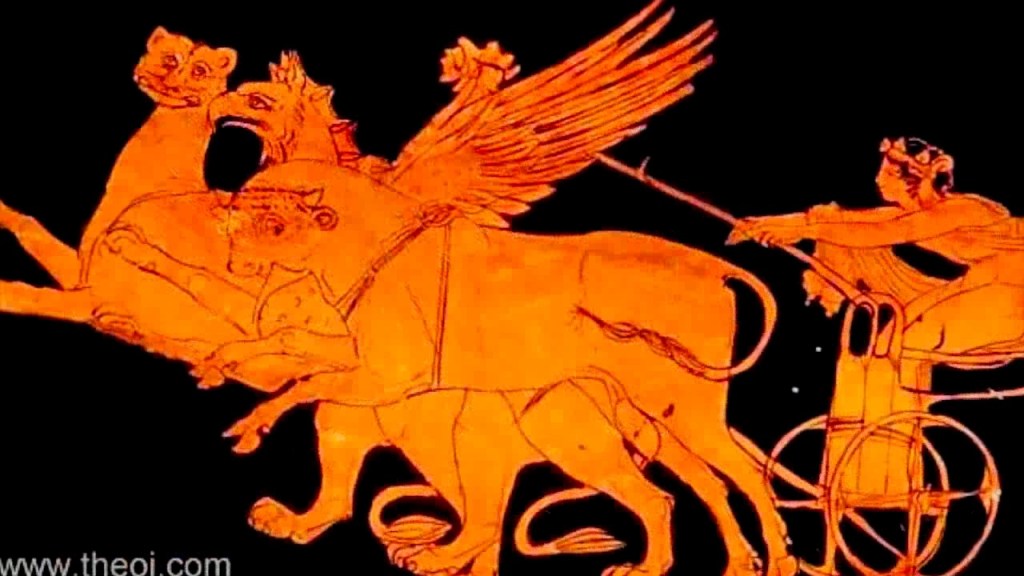
The soul is presented by Socrates as a charioteer in command of a pair of winged horses. The charioteer is the rational faculty nous or logistikon. The right-hand horse is the noble, honor-loving and responsive horse. The left-hand horse, or dark horse is the insolent and barely controllable horse, driven by appetite and urges. For Socrates, the ascension of the soul to the hyperouranian realm (the intelligible realm where the Forms reside) is a balancing act performed by the charioteer. This maps onto the 3 speeches. Lysias’speech is purely the dark horse. Favoring the non-lover, operating at a base and carnal urge, transactional love, this all minimizes intervention and the reigning in of the dark horse, and rhetoric is the mechanism it uses to accomplish this. The second speech, Socrates’s first is the charioteer (reason) suppressing eros entirely, meaning both horses, which leads to paralysis out of fear of the energy of the dark horse. Finally, the palinode (the third speech) corresponds to the charioteer in full control of his horse, by means of which he can successfully ascend to the realm of the Forms. The charioteer’s art consists in honouring the white horse’s impulse while restraining the dark horse’s. This isn’t to say its energy is rendered null, but rather first submitted, then redirected. Socrates explains that from this struggle arises a genuine philosophical companionship, the lover and beloved engage in discourse and in pursuit of knowledge, thereby ascending together.This redirection is important, because the dark horse provides the energy and impulse without which movement is impossible. Coincidentally, just as the charioteer steers and balances out two contrary forces in tension, so does the dialectician in his work, He collects and divides, only to reunite at the joints.
It is interesting to note the similarities and influences that Freud drew upon in his own tripartite model of ego, superego and id. Not to mention the redirection of the dark horse, that which he calls sublimation. Whether he drew upon the Phaedrus or not is unclear, but in the event that he did, it went uncredited. The major difference is that for Freud, there is no higher realm, all that sublimation is secular and gets redirected into “cultural works”, whereas for Plato it culminates in anamnēsis, which is contact with transcendent reality.
The Interdependence of the Maniai
Having covered the main themes of mania, the Forms, recollection and dialogue, we can try to further propose interpretations. Consider the philosopher’s forth and highest madness, the erotic mania. Such a person’s soul has been activated, it has seen something that transcends propositional language, which is why it registers as madness from the outside: outsiders looking on have not shared it. Further madness is required to contain it into a vessel, the philosopher must now make use of the Madness of the Muses. This is the capacity to make (poiein) something that did not previously exist in the sensible world. By enacting and not merely describing the vision, the philosopher-turned-poet replicates its destabilizing force in the soul of the reader or listener. The poetic madness supplies the form, but without the erotic madness, the poet has nothing of ultimate consequence to say. He is reduced to the treatise, to propositional assertion, to the dead letter and we need not say more about where that leads. The true philosopher as described by Socrates at the summit of the Phaedrus is convergence point of all four Maniai. He sees what is hidden (Apollo). He undergoes the dissolution of his false certainties (Dionysus). He creates forms adequate to his vision (the Muses). Finally, he is driven in all of this by erōs, the fundamental orientation of the soul toward what is beautiful, true, and real (Aphrodite and Eros).
Etymology of the words “sophisticated”/”sophistication”
As I was researching the trajectory of philosophical form with Claude, we arrived at present day academia. Here’s what Claude said that sparked curiosity in me:
“The journal article advancing a precise thesis through formal argumentation — has produced extraordinary technical sophistication at the cost of almost complete severance from the transformative dimension of philosophical practice.”
That word “sophistication“. I followed up on it and asked: “When we say this is that inherently a negative connotation? Is that derived from “sophist” or “sophia”? Claude continued:
The word “sophisticated” derives from sophistēs, which itself derives from sophia — but the route it took through history is precisely the story of the degradation Plato spent his career combating.
Sophia in its original and highest sense means wisdom — genuine understanding of what is. The sophistēs, in the earliest usage, was simply one who possessed sophia, a wise man, a master of a craft or domain of knowledge. Herodotus uses the term without pejorative connotation; the Seven Sages were called sophistai. It was, at its origin, an honourable designation.
The corruption — and Plato is more responsible than anyone for cementing it — occurred when the term became associated with the itinerant teachers of the fifth century: Protagoras, Gorgias, Hippias, Thrasymachus. These figures taught technē divorced from alētheia — skill in speaking, arguing, and persuading without commitment to truth. They charged fees for this instruction, which for Socrates was not merely distasteful but diagnostic: it revealed that what they offered was a commodity, a transferable technique, rather than the kind of understanding that can only be won through the soul’s own labour. The sophist sells the appearance of wisdom; the philosopher pursues wisdom itself. The sophistēs is thus the practitioner of sophia‘s counterfeit.
Now trace the English inheritance. “Sophistication” entered the language carrying this negative charge almost intact. Through the medieval and early modern periods, to “sophisticate” something meant to adulterate it — to corrupt a pure substance with an inferior additive. Sophisticating wine meant diluting or doctoring it. A “sophisticated” argument was a specious one, an argument that appeared sound but concealed a defect. The term was virtually synonymous with corrupt refinement, elegance in the service of deception.
The reversal into a term of praise is a relatively modern phenomenon, gathering force through the eighteenth and nineteenth centuries, and it is itself a case study in exactly the semantic collapse we discussed. The word that once named the disease — the substitution of impressive surface for genuine substance — gradually became a term of approbation for impressive surface. To call someone “sophisticated” today is to compliment their refinement, their worldliness, their fluency in complex codes. The critical charge has been almost entirely effaced. The word has, one might say, been sophisticated — adulterated by usage until it means the opposite of what it once diagnosed.
So when I used “technical sophistication” to describe the current state of academic philosophy, the irony is deeper than I consciously intended, and you were right to press it. The phrase is almost tautological in its original sense: what I described is sophistication — the production of elaborate, formally impressive discourse that has been severed from the transformative pursuit of wisdom. The academy has achieved mastery of the very condition Plato defined as philosophy’s antagonist, and has given it philosophy’s name. Plato would have found this grimly unsurprising. The sophist, he understood, does not oppose the philosopher from outside; he mimics him so effectively that the distinction becomes invisible — which is, of course, the subject of his entire dialogue The Sophist, where the Eleatic Stranger labours to distinguish the sophist from the philosopher and finds the task maddeningly difficult precisely because the sophist’s art consists in resembling what he is not.
 Λύκος
Λύκος 